Designing a Stronger DOT Air Brake System: Setting a New Standard for Tubing and Fitting Performance
Posted February 12, 2026
In DOT air brake and air suspension systems, components that often receive the least attention can become critical points of failure.
Compressors, valves, and actuators are carefully specified, modeled, and tested. Tubing, by contrast, is frequently treated as a commodity. Compliance with SAE J844 and FMVSS 49 CFR 571.106 may be good enough on paper, but real-world performance can tell a very different story.
Failures rarely begin with a catastrophic break. They start with small losses of strength and gradual elongation under load. Over time, micro-movements at the fitting interface weaken a connection that was never designed to withstand the stresses of everyday operation.
Tubing may satisfy regulatory requirements, but it doesn’t always provide the durability and reliability pneumatic set-ups demand. Alkon DuraLink™ DOT tubing is engineered to go beyond the minimum, delivering proven strength and sustained function where it matters most.
Why Tubing Fails Before Fittings
DOT tubing faces a combination of stresses that laboratory tests cannot fully replicate. It is exposed to vibration from the drivetrain and road surface; continuous pressure cycling; wide temperature swings; contact with chemicals and road salt; and mechanical movement at fitting interfaces.
Under these conditions, tubing does not fail suddenly. It elongates. It creeps. It relaxes.
As elongation increases, grip strength at the fitting interface decreases, pullout risk increases, and micro leaks develop. Even connections that passed initial testing can lose their safety margin.
In many roadside malfunctions, the fitting itself is not the root cause. The tube has simply lost the mechanical properties needed to remain secure under pressure.
This is why tensile strength alone is not sufficient. Elongation is equally critical: a tube that stretches excessively under load will eventually compromise even the best fitting.
SAE J844 Testing: Insights and Limitations
SAE J844 establishes standards for DOT air brake tubing, ensuring a baseline of safety. However, these tests do not guarantee extended service life in harsh conditions.
While regulations specify required tensile strength and elongation values, many products meet only the bare minimum, leaving little margin for real-world conditions. As a result, two tubes that comply with the same specification can behave very differently in the field.
One may maintain its mechanical properties over years of pressure cycling and thermal exposure. The other may slowly lose strength, elongate under sustained load, and become vulnerable to pullouts and leakage.
Compliance confirms that a product is acceptable on day one. It does not indicate how it will perform on day one thousand.
Why Tubing and Fittings Must Be Engineered as One System
In most supply chains, tubing and fittings are sourced independently, often from different manufacturers. Each is designed to meet different internal tolerances, material formulations, and performance priorities.
While the components may be DOT-compliant individually, the interface between tubing and fittings can become the weakest point in the system.
This interface is where grip geometry, tube hardness, surface finish, and wall consistency all interact under pressure, vibration, and thermal cycling. Even small mismatches can significantly reduce pullout resistance, compromise sealing reliability, and shorten the operational life of the pneumatic assembly.
For this reason, tubing and fittings cannot be evaluated alone. Trusted Performance depends on how they function together.
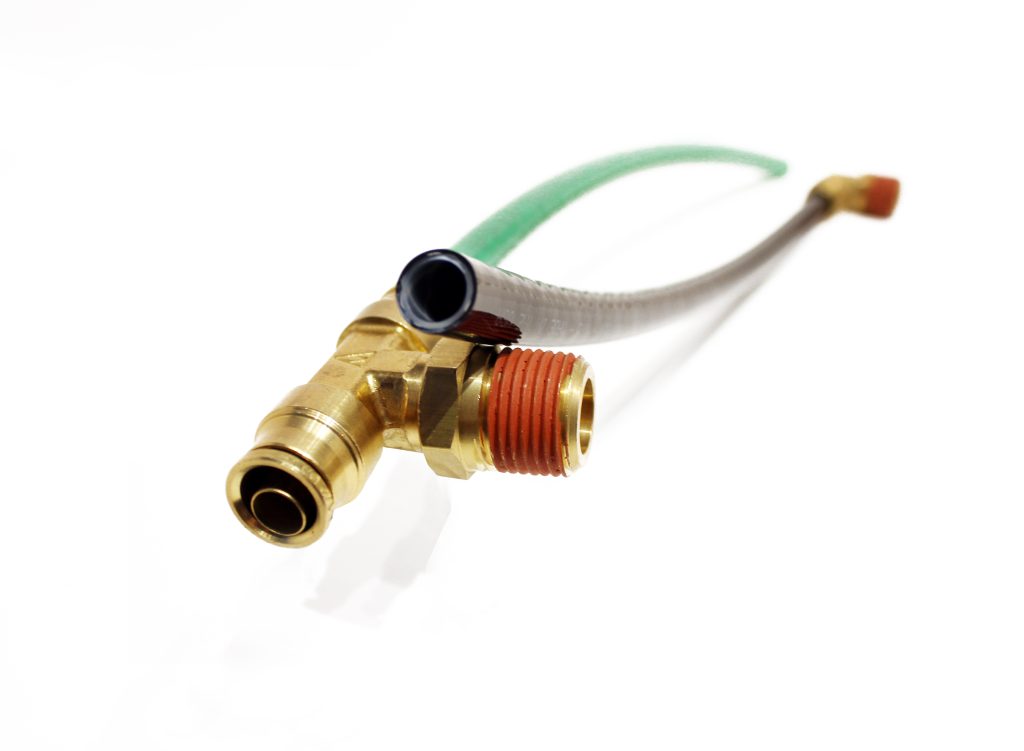
DuraLink tubing was engineered with this system-level interaction in mind. It pairs seamlessly with Alkon push-to-connect fittings and works dependably with competitor fittings as well.
What Alkon’s Testing Revealed
Alkon conducted extensive tensile and elongation testing on DuraLink and competitive tubing. The results were striking.
DuraLink exceeded SAE J844 requirements, achieving more than twice the required tensile load and over three times the required elongation. Competitor tubing often delivered only a fraction of DuraLink’s elongation. Under more aggressive loading, many competitor samples failed to meet the benchmark entirely.
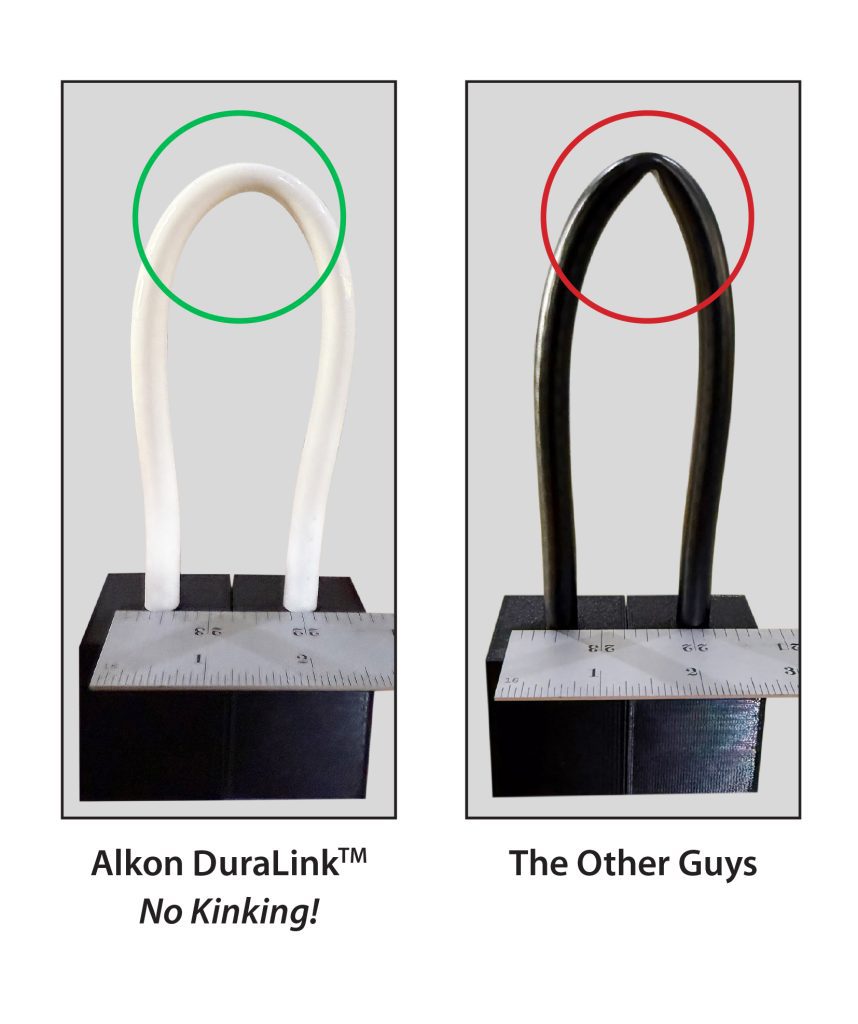
Bend testing further demonstrated Duralink’s ruggedness. It maintained its integrity at tight bend radii, while competitor tubing frequently kinked or collapsed.
Even more revealing, pairing competitor fittings with Alkon DuraLink tubing dramatically enhanced capability. In some cases, switching to DuraLink tubing resulted in elongation increases by more than 140% and tensile strength improvements by over 40%.
These results confirmed what field experience had long suggested. The tubing, not the fitting, is often the limiting factor in system performance.
The True Cost of Tubing Failure
Tubing failure is rarely just a matter of replacing a part. The true cost extends far beyond the price of the tube.
For OEMs, tubing issues carries the risk of brand damage and warranty claims. For fleets, a single defect can lead to downtime, missed deliveries, and higher operating costs. Missed deliveries do more than disrupt schedules; they can also damage brand reputation and erode customer confidence. For distributors, failure often results in callbacks and dissatisfied customers.
In safety-critical systems, one weak component can trigger an array of problems, leading to secondary damage, liability exposure, and expensive roadside service events.
When it comes to DOT tubing, the cheapest option can quickly become the costliest.
How DuraLink Was Designed Differently
DuraLink was developed with three primary objectives:
Exceed the standard by a wide margin. Not simply meet it.
Maintain long-term performance. DuraLink retains its mechanical properties over years of service, not just in initial testing.
Deliver consistent quality. Uniform production creates tubes that deliver dependable operation over time and across applications.
These objectives guide every aspect of Alkon’s tubing. Material formulation, wall control, surface finish, and process stability combine to provide high-level results under demanding conditions. DuraLink is rated for extreme temperatures from -40°F to +200°F and handles working pressures up to 145 psi.
Equally important, DuraLink is manufactured in the United States under controlled processes that support supply chain stability and robust quality.
With DuraLink, reliability and performance aren’t optional. They are built into every foot of tubing.
Designing for Confidence
In DOT air brake systems, safety is not created by any single component. It comes from how all the components work together.
Designing for confidence means planning for margin, consistency, and durability in conditions that exceed laboratory assumptions. DuraLink supports that philosophy. It’s not a replacement for commodity tubing, but a system-level solution for applications where failure is not an option.
When tubing and fittings function as one system, the result is not just compliance. It is confidence in every connection.
Want to learn more about Alkon’s DuraLink™ Solution? Visit our DuraLink Mobile Tubing page for complete technical details, design specifications, part numbers, and additional resources.